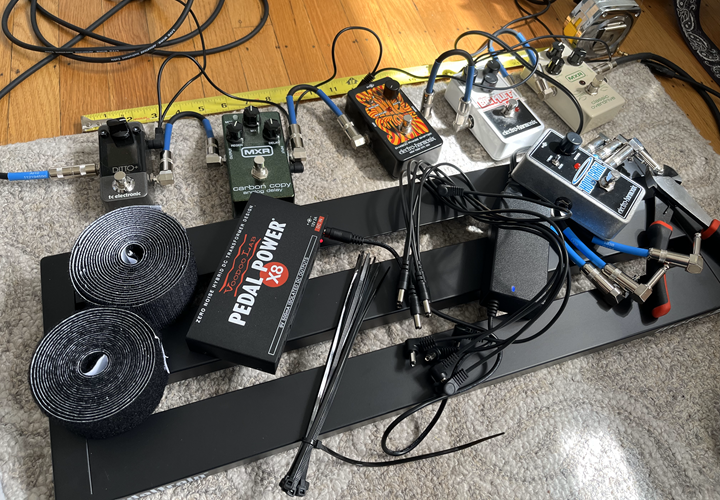
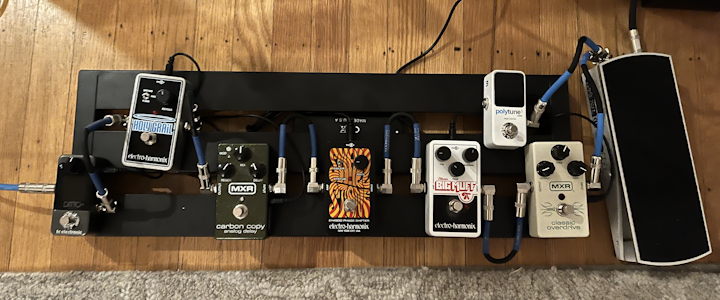
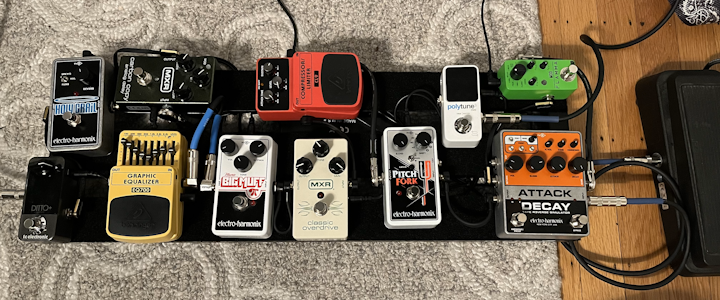
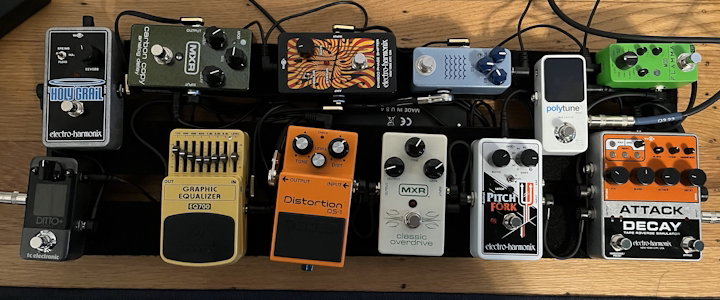
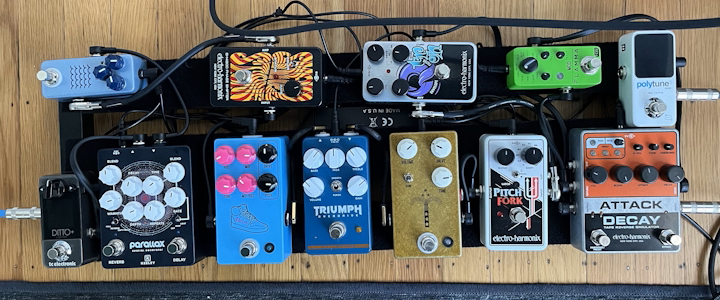
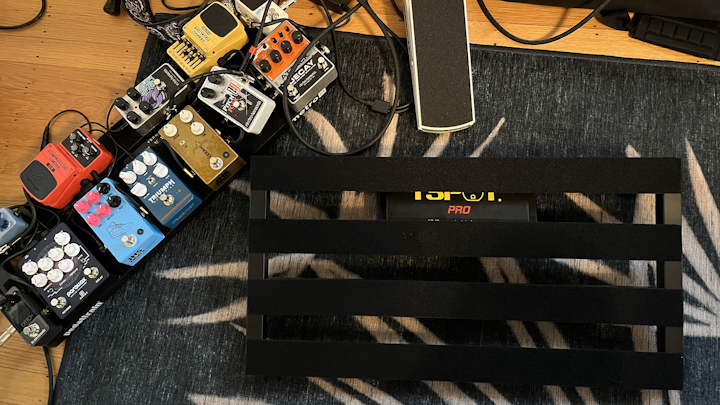
Rail height. The 3 rails of the Metro 24 is an awkward height. Most pedals are 2 rails worth of height, a wah or volume pedal is 3 rails high, but those are less central to me and I don’t mind having those off the board. There are pedal switchers that are 1 rail height, but if you only have 1 row of pedals I’m not sure those are needed. So if you’re just doing regular sized pedals on a 3 rail system you’re going to end up with sideways pedals to use the whole space. I wanted to increase to 4 rails so I could get 2 parallel rows of regular sized pedals.
Power supply fit. The flat Metro 24 did technically fit my power supply underneath, but it was a tight fit that meant that the power connectors had to all be right angles to fit at all, which for the cords that came with it meant the pedals had to take the straight connectors which created other fit issues. Better off planning of a matching power supply to solve this.
Number of power outputs. The power supply had 8 outputs, which seems generous but I was able to fit more pedals than that on the board. So I ended up daisy chaining off some of those isolated outputs. And with that I started to introduce noise issues.
Tuner staging. The volume pedal had an output for a tuner, which allowed me to use the volume pedal to mute while tuning. I like that better than using the foot switch on the tuner itself. However with the volume pedal off the board this introduced another cable that had to be managed when packing/unpacking the board. Not worth it.
Combo pedals. Due to the strain I was putting on the number of pedals and density of cables, I started to see the value in combo pedals (e.g. reverb and delay in one). These combo pedals can cut down on overall complexity
Patch cables. Flat patch cables are a must. The Livewire ones I picked up at Guitar Center were too bulky and stiff, making it hard to get a nice tight board. I’m not really interested in cutting/soldering my own, especially as I’ve been experimenting rapidly, so I needed storebought fixed length cables. The MXR cables were okay… still a bit bulky. The best I found were the EBS Premium Gold Flat (flat and flexible). But I filled out the board mostly with Rock Stock cables that gave me a variety of lengths for a reasonable price.
Velcro. The original video I referenced to build my board recommending using minimal velcro to attach pedals. Maybe that’s okay if you’re going to leave your board in one configuration, but I was experimenting and moving things around. For my next board, velcro all the way across.
It was time to build my second board. After more research I landed on two essential choices:
Another key lesson was planning for the power draw from each pedal to make sure I knew which output to use for each and where I could afford to daisy chain. Thankfully there’s a website to help with that, and I was able to build a table to help plan for my next board:
Brand
Model
Power (mA)
Behringer
EQ
8
Behringer
Compressor
30
EHX
Attack Decay
140
EHX
PitchFork
25
EHX
Small Stone
12
EHX
Q-tron
10
JHS
PG-14
67
JHS
Tidewater
3
JHS
Morning glory
43
Keeley
Parallax
75
TC Electronics
Ditto+
100
TC Electronics
Polytune3
44
Wampler
Triumph
21
BOSS
DS-1
4
BOSS
RC-10R
250
Next up, I’ll cover the pedals and signal chain on the new board.
There’s no single agreed upon rating system for all things. Sometime we use a 5 star scale. Sometimes a 10 point scale. Sometimes A-F letter grades (where maybe “S” is part of system). Sometimes thumbs up or thumbs down. Sometimes a heart vs. the absence of one.
Different rating systems may be preferred depending on how much time we spend with media. A song, averaging around 3 minutes long, probably doesn’t require a detailed 5 star scale; a simple “heart or not” system is plenty. Movies we spend a couple hours with, so they seem to warrant more. Video games may get a dozen or more hours, and that seems more likely to land a 10 point scale. But hey, each reviewer is going to do their own thing. And review aggregation sites are going to turn that into number soup. But there is some rhyme to which rating scales we pick for which things.
The predominant resource on board games is Board Game Geek, and BGG asks its users to rate games on a 10 point scale. Not only that, but they provide suggested definitions for those values.
10 - Outstanding. Always want to play and expect this will never change.
9 - Excellent game. Always want to play it.
8 - Very good game. I like to play. Probably I’ll suggest it and will never turn down a game.
7 - Good game, usually willing to play.
6 - Ok game, some fun or challenge at least, will play sporadically if in the right mood.
5 - Average game, slightly boring, take it or leave it.
4 - Not so good, it doesn’t get me but could be talked into it on occasion.
3 - Likely won’t play this again although could be convinced. Bad.
2 - Extremely annoying game, won’t play this ever again.
1 - Defies description of a game. You won’t catch me dead playing this. Clearly broken.
You may notice that this scale is mostly oriented around desire to play. That’s a reasonable index, but not the only one. It’d be weird if we primarily reviewed movies based on your interest in seeing them again. We fully accept that a movie can be seen once and never returned to, but still be great. But as physical objects that take up space in your home, board games seem held to this standard of “how much value are you getting out that shelf space?”
So, how do I rate my games? Since BGG has definitions for their rating system, I try to adhere to that as closely as possible when rating on their site. But there are other factors. It’d be uninteresting to me to have a perfect 10 game only be a function of endless desire to return to it. How the game makes me feel? What memories does it has the capacity to form? Does community flow from the game, can it make bonds? And yes, is it an appropriate price for the quality of experience? All of this factors in.
So, here are some representative examples for each rating.
10
Outstanding. Always want to play and expect this will never change.
Anything at this rating has to be truly special. Dare I say… meaningful? Impactful, sustaining, and something that really captures my identity.
Star Wars: X-Wing Miniatures Game. I have played close to two hundred matches of this game. I have played in tournaments. I have made various after-market customizations to enhance my experience playing the game. I followed its evolution over many years, eagerly tracking every news article. I have fond memories of playing with specific people and leaning into the whole experience of this game. It’s captured my imagination and brought me real joy. It’s a 10. What else could it be?
Another example: Skull, in my opinion, a perfect game.
9
Excellent game. Always want to play it.
This rating is only for great games that stand above most, but maybe don’t quite get into the truly rarified air of my greatest of all time.
Just One. I’ve never not had a delightful experience playing this simple word game. It works for kids and adults. You can drop in and out. It doesn’t exactly capture my imagination and live rent free in my head. But it’s a reliable good time. Incredibly solid.
Alternate example: Kemet, a heavier game by comparison that has shown itself to hold up to dozens of plays.
8
Very good game. I like to play. Probably I’ll suggest it and will never turn down a game.
A game that garners an 8 is truly solid. It’s going to be beloved by me, but not entirely unconditionally.
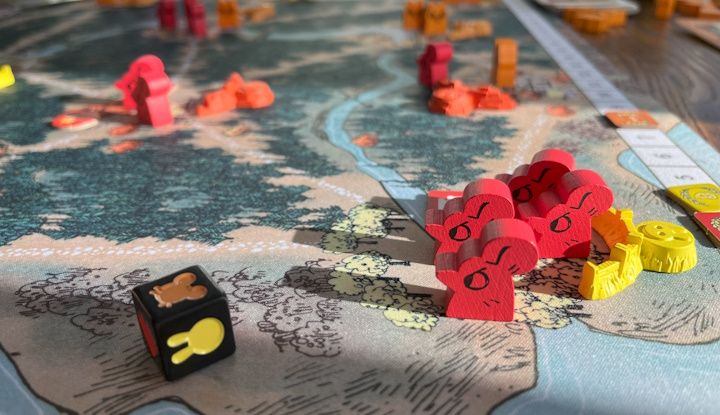
Root. I can’t picture myself turning down a game of Root. It’s such an interest piece of design and art. But for sure it’s not for everyone. It can be hard to teach (although not as hard as people think). I’ve heard it described as too clever for its own good. But I love it.
Alternate example: King of Tokyo is worth acknowledging as a popular late night game with many of my friends. I’ve cooled on it, but only after it wracked up almost a hundred plays.
7
Good game, usually willing to play.
I own a lot of 7’s. They’re good. They’re just not quite great for one reason or another.
Ra. I very much enjoy this classic auction game. But I’ve seen firsthand how the random swings and missed opportunities can really frustrate and alienate other players. I think my experience with this one would be rated higher than others, but it’s not a solo game and I have to recognize that something keeps it from landing.
Alternate example: Android: Infiltration. Is a push-your-luck heist game that has shown surprising longevity. It has real flaws, but it’s got some magic too.
6
Ok game, some fun or challenge at least, will play sporadically if in the right mood.
A lot of games are going to sit at this rating. I’ll play them if someone else is feeling drawn to it, but I’m not often going out of my way.
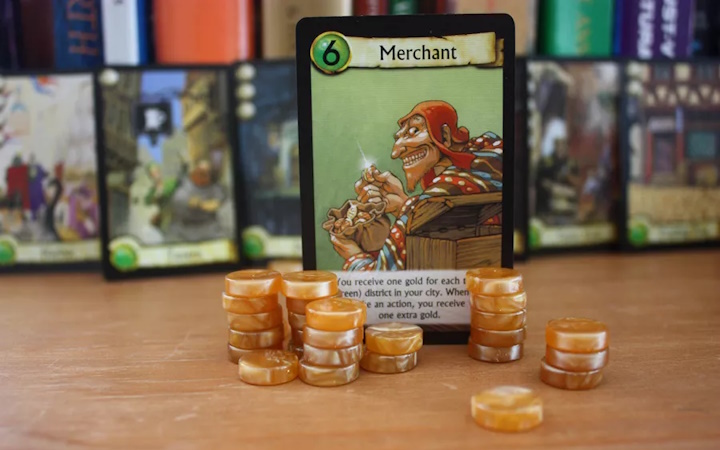
Citadels. I’ve certainly had fun with this one. But it’s got some mean edges. And the building aspect is pretty thin. There are other role selection games that are often going to be a better use of my time (like Libertalia or Mission: Red Planet).
Another example: Kingdomino is perfectly fine. It has an interesting drafting mechanism and is easy to teach. But it’s not pulling me in.
5
Average game, slightly boring, take it or leave it.
Average games are average. There’s nothing terrible here, but we deserve better than average for our time.
Century: Spice Road comes to mind for this rating. It’s a bunch of resource conversions and recipe fulfillment. It’s fine. It’s decidedly average.
Another example: Catan was once exceptional, and is now average in the robust feast of modern board games we have available today.
4
Not so good, it doesn’t get me but could be talked into it on occasion.
A 4 rating means is not for me but is for someone.
Talisman is not something I’m interested in. It’s a role-to-move with fantasy adventure theming. I’ve never felt like winning was the product of clever play.
Another example: Canvas fell flat for me as a component gimmick without much game behind it.
3
Likely won’t play this again although could be convinced. Bad.
If a game is a 3 then that means I’m pretty sure it’s terrible but I hold a small sliver of hope that I’m wrong.
Munchkin is not my jam. The entire experience devolves into tearing someone down in their moment of joy. It has a humor to it, but not enough to make me want to play.
Another example: Steam Up: A Feast of Dim Sum has the most lovely components with its steam trays. But I found the act of watching other players rotate my agency away turn after turn infuriating.
2
Extremely annoying game, won’t play this ever again.
To earn a 2 rating you need the confidence of being never worth another look.
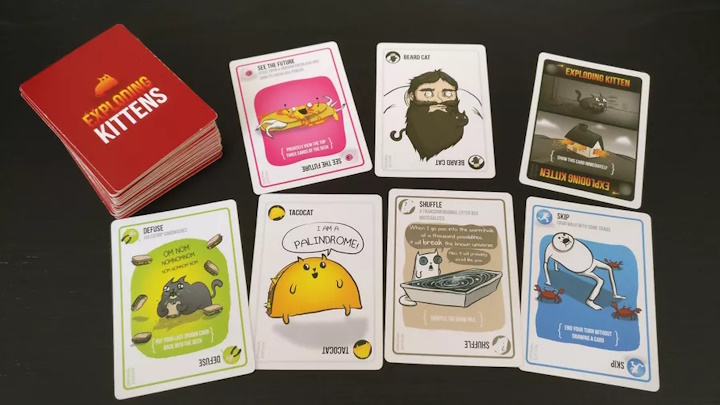
Exploding Kittens has its audience. To me it’s just some random shit happening. No thanks.
1
Defies description of a game. You won’t catch me dead playing this. Clearly broken.
I’d guess that most 1 ratings on BGG are hateful review bombing, not actual thoughtful criticism. I’ve only ever given it out for this literal description… is this even a game? Am I missing something because it doesn’t even seem to function.
Doggy Go! is the only example I found where I gave out a 1. I grabbed it from a convention library and literally couldn’t figure out if it was a game or just some objects you were expected to use to find your own path to fun.
My first electric guitar was a hand-me-down from my uncle, given a few years after I started playing guitar in elementary school. It was the era of grunge, and much of the music I was listening to was filled to the brim with distortion. A stark contrast with my modest electric setup. And yet, when I assembled my own money to buy my first ever guitar pedal… I hipstered myself. I could have bought a distortion pedal like the Boss DS-1, used prominently by Nirvana and so many others. Or a Big Muff Pi fuzz pedal, used heavily by the Smashing Pumpkins. Or I even could have bought a delay pedal to do my best impression of U2’s The Edge. But no… I decided at the last minute to get something quirky and “unique”: an octave pedal, the DOD Octoplus. It was immediately clear I had made a mistake. An octave pedal can have its uses, but as a first and only pedal? A dismal choice. And I had no money for a second pedal.
The end result? I spent the next 25 years primarily only playing acoustic guitar.
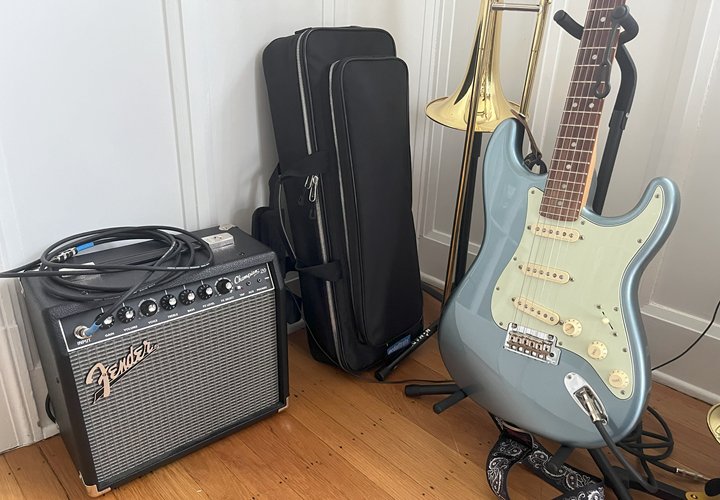
It wasn’t until I was 40 years old that I actually bought myself my very own electric guitar (a Fender Stratocaster, classic and versatile). It only took a global pandemic to push me to make the purchase, stuck inside with an evaporated social calendar. But I was ready to do it right, and get pedals too. I did a lot more research this time (thanks dramatically more developed internet!). So without spending too much money I got some classic building blocks.
It was enough to let me fool around and enjoy myself. But in time, life started to normalize. I couldn’t continue to leave this awkwardly daisy-chained cluster of pedals and wires out on the floor. They got shuffled away, to come out sporadically. Inconvenient set-up and clean-up prevented this from being a regular practice.
Years later, I moved into a bigger house. Literally the first things I moved over were my instruments. After breaking it in with my acoustic guitar, I realized I could set up my electric guitar, amp, and pedals in this new space. The moving boxes hadn’t yet arrived, but I filled that empty house with some epic fuzz. For a moment, it was glorious. But the pedals were still a mess of tangled wires, so I moved everything into the basement. Sadly out of sight, out of mind, and underloved.
After over a year of being in the new house, with the financial pressure reduced, I felt like I could explore solutions to this problem. I had long ago learned that an instrument in a case never gets played but an instrument on a stand does. You have to remove the friction between you and the behavior you want. An effects-free electric guitar is okay, but never is going to be a draw over my acoustic. However, an electric guitar connected with all sorts of toys is a totally different story. So I needed a way to organize the toys.
Enter the pedalboard.
I was aware of the concept of a pedalboard, but having no experience I turned to YouTube. I sampled a few tutorial videos, but the one that got me there was this one from JHS. Not only did it walk me through everything I needed to build my pedalboard, but it also sent me down a rabbit hole of an incredibly entertaining and well-produced channel all about pedals. It was not a cheap discovery.
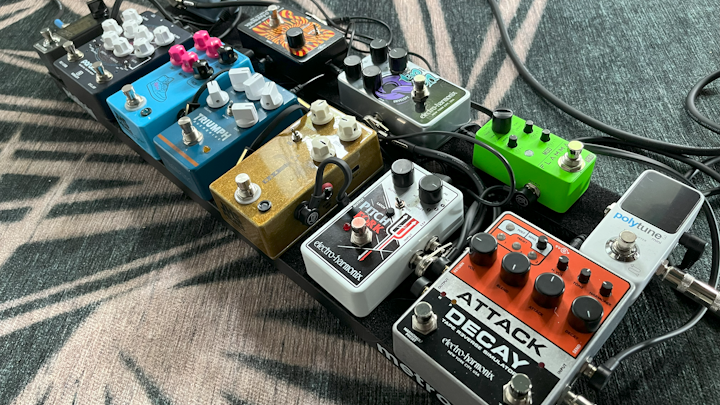
Knowledge in hand, I waltzed into Guitar Center to pick up the board (a Pedaltrain Metro 24), the power supply (Voodoo Lab Pedal Power X8), and some patch cables. And while I was there… I grabbed a pair of used pedals to round out my options:
For some reason the sales associate tried to talk me out of buying any TC Electronic pedals. Which is funny, because their looper would become the single most effective tool in getting me to play my guitar. More on that later. So the internet provided 2 more pedals to round out the rig:
Imagine a time lapse here of lots of velcro, threading power cables through the board, and maneuvering stiff patch cables. But I emerged victorious.
But most importantly, it solved my problem by enabling everything to be put neatly away at a moment’s notice. Immediately I started playing a lot more. I had my looper pedal to give me a way to layer my creativity. I had fun noise machines at my feet. Mission accomplished.
But Pandora’s box had been opened. I had created a platform for experimentation, and introduced to myself to a whole field of guitar effects to lust after. What followed was a period of rapid experimentation and expansion fueled by the combination of The JHS Show and reverb.com.


 My first electric guitar was a hand-me-down from my uncle, given a few years after I started playing guitar in elementary school. It was the era of grunge, and much of the music I was listening to was filled to the brim with distortion. A stark contrast with my modest electric setup. And yet, when I assembled my own money to buy my first ever guitar pedal… I hipstered myself. I could have bought a distortion pedal like the Boss DS-1, used prominently by Nirvana and so many others. Or a Big Muff Pi fuzz pedal, used heavily by the Smashing Pumpkins. Or I even could have bought a delay pedal to do my best impression of U2’s The Edge. But no… I decided at the last minute to get something quirky and “unique”: an octave pedal, the