
Board Games in 2024
06 Jan 2025The primary way my board game playing expanded this year was due to conventions like GenCon and OrcaCon; generally I aim to play games before purchasing them and conventions are a great way to do that. On the whole I had fewer logged plays than 2023. I think 2025 needs to be a year of reestablishing a game playing community. But for now, here are the board games that I played in 2024 that I have something to say about.
Faraway
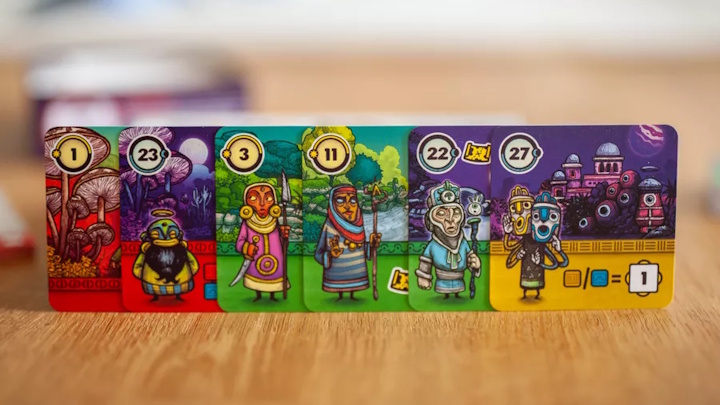 Build an engine in reverse while drafting one card at a time. This game goes by wicked fast and through the whole thing you’ll be working out how to adapt your strategy. Play cards in ascending numeric order and you get you an enticing bonus card, so there’s this great tension of seeking the right play order. There are regular interesting decisions, a short play time, and it comes in an appropriately small package. Fantastic small box game.
2-6 players, 15-30 minutes
Things in Rings
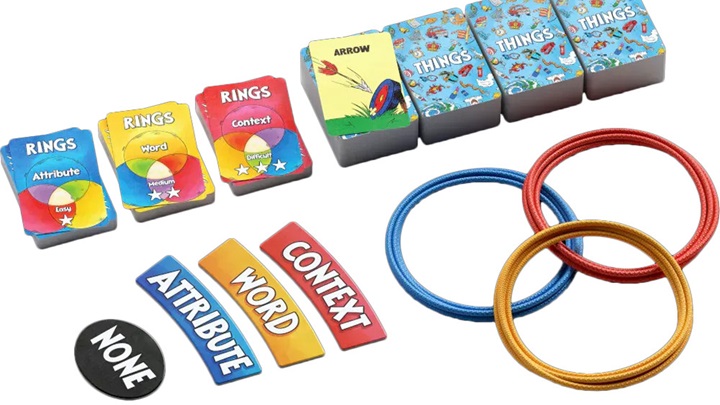 This is Venn diagrams as a party game (although can technically be played with as few as 2). One player knows the rules of the circles (for example “is a five letter word”, or “is made of organic material”) and the rest tentatively place cards in them to see if they have inferred the meanings. Make a mistake and draw more cards. Your goal is to play out all of your cards. I’ve only played it as a cooperatively puzzle but it does have a competitive mode. The art on the cards is charming, and playing with Venn diagrams in physical space is delightful.
2-6 players, 20 minutes
Wilmot’s Warehouse
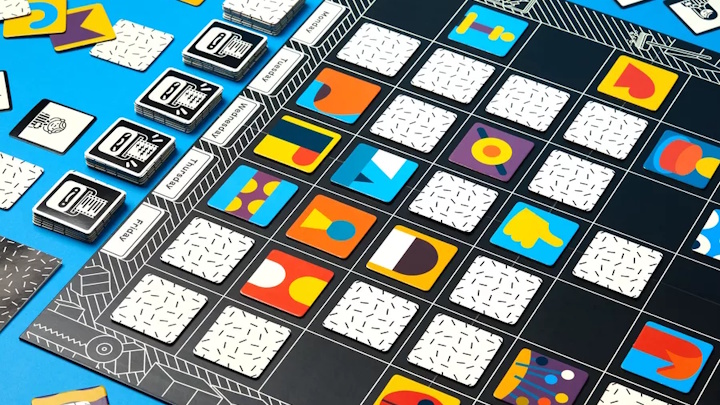 I wouldn’t have thought I’d have loved a memory game this much. But turns out storytelling with friends as a means to mitigate memory is very much my jam. This is a fun bonding activity that everyone can enjoy.
2-6 players, 30 minutes
Daybreak
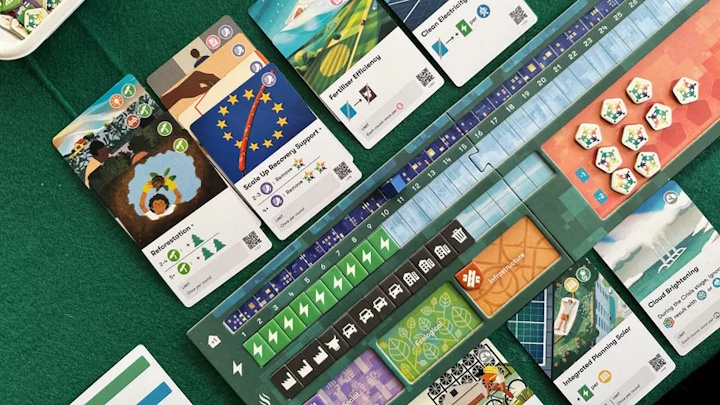 This game aims to both teach and be fun, which is not easy. And I think it pulls it off. You have asymmetric nations doing work to address the climate crisis. And through the gameplay they will realize that they have to work together, leveraging each other’s strengths, or civilization is going to collapse. I’ve found that not everyone clicks with this game. Which is too bad, because I enjoy the puzzle and the very relevant storytelling that emerges from the mechanics.
1-4 players, 60-90 minutes
Oceans
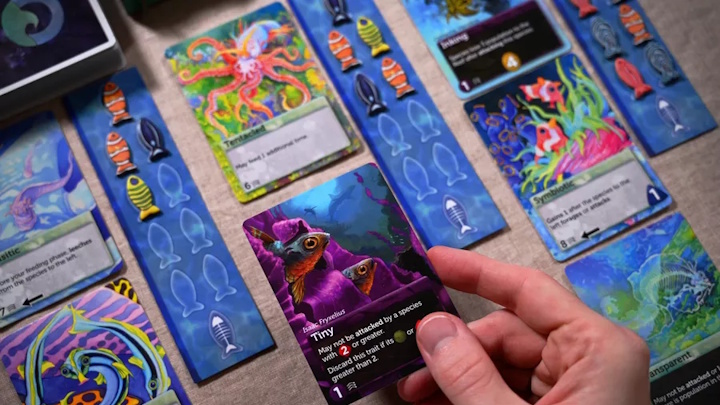 I’ve enjoyed the core gameplay ideas of past Evolution games, where you create and adapt species to compete for food and population growth. Oceans takes most of those ideas and adapts it for a dedicated aquatic environment with lovely colorful artwork. Then it mixes in a “deep” deck of crazy unique effects. So you combine some core heavily balanced traits with the spicy effects which creates an excellent blend of understandability with variety. Maybe you’re a predatory super shark, or a lurking bottom feeder, or a plankton-scooping anchor species… the confrontation between players feels like building an ecosystem. It works better than any of the other variants on the Evolution series.
2-4 players, 60 minutes
Harvest
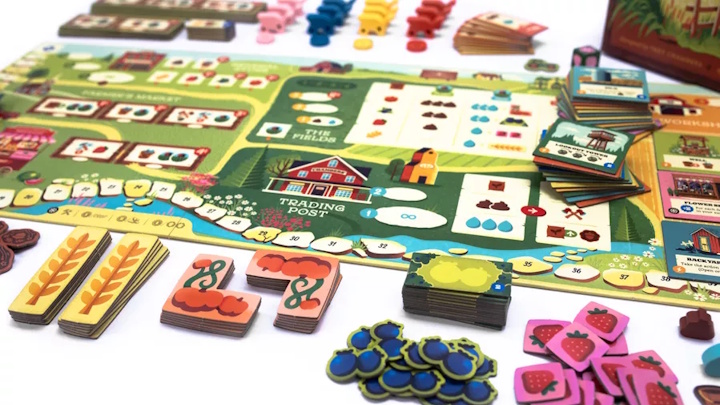 The first thing you’ll notice about Harvest is the absolutely adorable art and excellent production put on by Keymaster. Anthropomorphic animals farming, but is it fun? I think it is. It’s a worker placement game where you compete for the most productive spots and really feel that tension. You need to balance planting and harvesting crops, clearing more space on your farm, and layering together passive upgrades. It’s an engaging little puzzle in great packaging.
1-4 players, 30-60 minutes
Cities
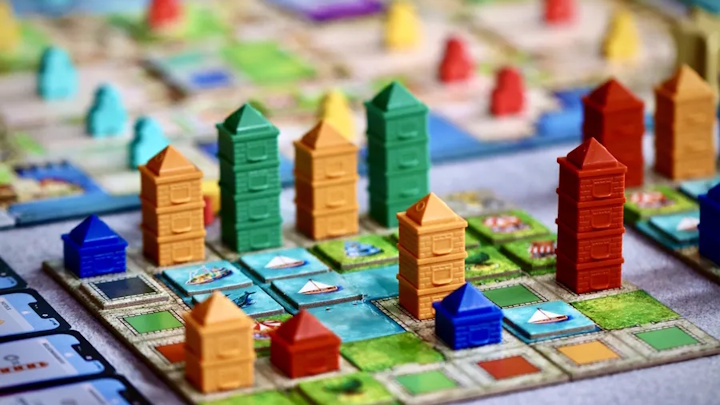 Bright, snappy, and beautiful. Place tiles, buildings, and decorations while collecting the scoring conditions that make the most of all of those. The 4 category worker placement draft plays out well and quickly. So far this game has been a smooth teach and a pleasant time.
2-4 players, 30-40 minutes
So Clover!
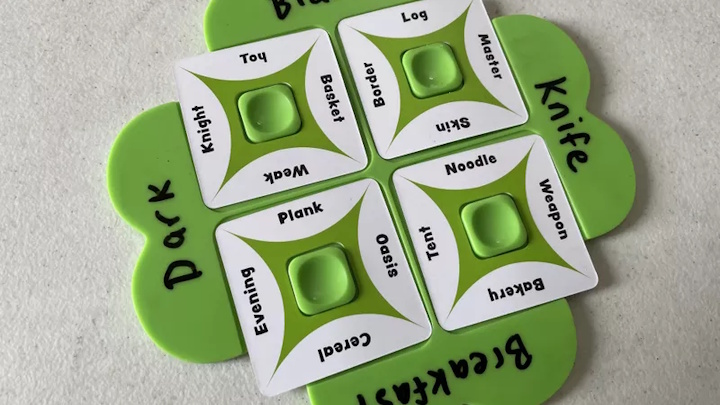 Language is so nuanced that it provides a lot of space for games that are just about the confusions and collisions of words. So Clover is a word game where one player gives a set of clues to link word pairs. Each player takes a turn being the clue giver (and can do the prep part simultaneously) The gimmick is that the pairs are on individually rotatable cards, so there are many combinations that could play out. Additionally, a random card is thrown in after the clues are locked in, just to create unexpected associations the clue giver couldn’t plan on. The experience of play is either as a clue giver watching people misunderstand your inferences, or as players cooperatively solving a word puzzle; either role is fun in its own way. This is an easy game to recommend for pretty much anyone.
3-6 players, 30 minutes
Dune: Imperium – Uprising
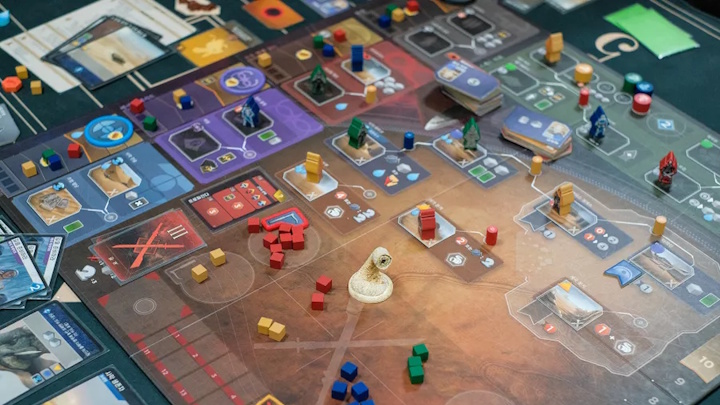 As an IP, Dune has spawned many good games. This latest one is a deck building and worker placement hybrid. The deck building part is light compared to other games where that’s the focus. The worker placement takes much more of the focus, with varying spots becoming essential to land at the right moment. This all culminates in occasional battles where what you’ve accumulated gets thrown together with hopes to come ahead. It’s crunchy but thematic. It takes just the right mood to get to the table, and it certainly doesn’t resolve quickly, but there are many interesting decisions over its play time.
1-6 players, 60-120 minutes
Space Base
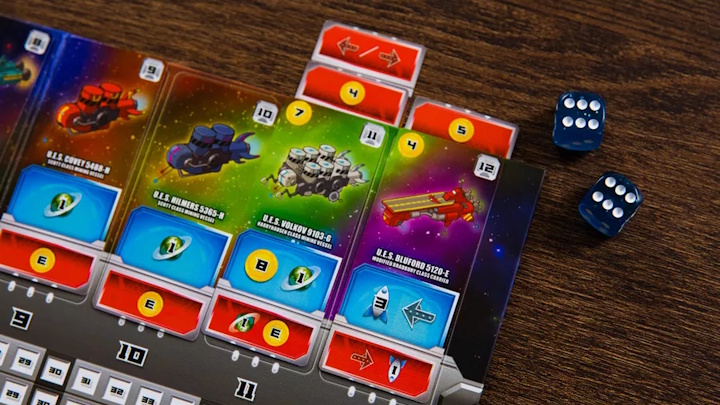 Roll two six-sided dice, use the values either individually or as a sum to trigger your spread of 11 spaceship abilities. Gain currency, purchase new abilities to replace old ones, and transform old abilities into less powerful versions that trigger on other player’s turns. It’s a similar core formula as something like Machi Koro, but there’s a lot more depth of strategy to this one. I’ve mostly played this at 4 players, where the flip abilities (red) are far more important than what you roll on your own turn (blue). It’s a game where you care just enough about what’s happening on other player’s turns, the turns themselves are quick, and there’s enough game length to build a strategic arc. Over the past few years this game has had a ton of play in my friend group.
2-5 players, 60 minutes
And the Rest
Here are some other games I dug into this year. Some of these might warrant a stronger recommendation in the future but I don’t have the repition of plays to back that up. Or they just might not be for everyone.
Cooperative
- Sleeping Gods: Primeval Peril: A misfit crew is mysteriously lost on a winding jungle river, with hazards and misfortune all around. Can you work together to escape? This is a storybook game (as in with a book with passages you read aloud), with randomized skill challenges, equipment, and monster combat. I’m not sure how much replayability there will be for the same scenario (you’re always going through the same map and the same story book), but I think enough for its value. A good option for a cooperative narrative evening.
- Marvel United: X-Men: Cooperatively match up a few of the X-Men against Magneto to save the city. Or maybe swap out Cyclops for Gwen Stacy and instead put them up against Loki. Mix and match to your heart’s content. Certainly some of the charm of this game is in combining the different character powers (and their miniatures) into your own fan fiction. The mechanics are actually very simple, and the differences between those characters are executed with a light touch. This ends up being a family friendly co-op that can be tailored to the specific character affinities of your family.
- Witchcraft!: An attractive and well themed solo game. As solo games should be it was challenging and often involved finding the lesser of two evils. I liked the tension between when you reveal your witches to get powerful effects versus sustaining for the longer marathon. As with many solo games, this works well played with a partner to help you work through the challenge.
Head to Head
- Land vs Sea: If you know me you know I like maps. This is a game about building a map competitively out of tiles, one player optimizing for land features and another player for sea features (and with more options at higher player counts, but I haven’t tried those). I do think it’s awkward that the game has two-sided tiles where the two tiles in your hand are actually four options but you can’t see them all at once. Space efficient but fussy. Other than that the game is pleasant if not terribly deep.
- Pagan: Fate of Roanoke: I’ve only had a learning game of this, and there was much learning to do. But I love the theme and I love the quirky Netrunner-esque gameplay. I’m eager to get in more games and see how it improves with better understanding.
Good to Play with Kids
- Captain Flip: Simple, colorful, and doesn’t overstay its welcome. You can push your luck on way to building your ideal chain of crew members, and maybe get burned.
- MicroMacro: Crime City – Full House: Solve a mystery by scrutinizing a map. It works. The art is inviting and the mysteries I’ve tried so far have been satisfying to solve. This is a delightful activity to pull out with kids.
- Hideous Abomination: Lots of high profile overblow Kickstarter funded games succeed based on artwork but fail in the end experience because art is only one slice of that. However if art is by design a large portion of the experience… well then that can be okay. In this tile laying game… it’s all about the art. You make crazy impossible creatures out of tiles and delight in how they look. There’s a game too… but that’s honestly very little of the focus. It works well enough to not get in the way of enjoying the look of your monster in the end.
Small Boxes
- Courtisans: A breezy card game where you draw three cards, take one for yourself, give one to another, and allocate one to the final scoring. Just a few power cards kept this an easy teach. Moves quickly and had plenty of mind games along the way.
- Moving Wild: A 3 stage draft where you are trying to match up animals to habitats. The challenge is that the animals might be picky and the habitats have limited space. I enjoyed trying to land that perfect balance, alongside planning from one draft round to the next. Plus Oink games are generally a win due to their extreme portability and gentle use of shelf space.
- Hitster: There’s a deck of cards, each of which has a QR code. Scan it, and a song plays with Spotify. Now you try to progressively place it in a timeline with other song cards. Which came out first, “Wonderwall” or “Wannabe”? If that sounds fun to you, it is. As a bonus you can challenge to name the artist and/or song title, serving as a “name that tune” type experience.
Medium Weight
- Middle Ages: What a delightful production. Puzzle piece cardboard tiles and positively adorable wooden pawns, all with gorgeous art. The drafting mechanism feels like Kingdomino but with more foresight. The attack buildings are sure to be polarizing (especially since the game punishes for you not dabbling in all building types).
- Bosa: Lightweight and colorful, in a very attractive box. Decidedly pleasant. Easy to teach.
- Forest Shuffle: By the end of the game what you’ve accumulated may feel a bit out of control with the compound complexity. But this is a satisfying blend of layering engine and scoring conditions from a mess of cards and hoping your opponent doesn’t take that care you really really need.
- Kronologic: Paris 1920: A clever deduction engine. I like how there is public information that has you paying attention on other player’s turns, but also private information that helps you race to solve the mystery. Attractive components, and enough variants in the box that it seems like a reasonable value. May be good with older kids, but I haven’t tested that yet.
- Mezen: What a striking production with sharp intentional color and art. And with it, a puzzle of adapting your every changing grid to match slowly unfolding scoring conditions. I like that you are rewarded for planning a couple turns ahead but don’t need to sweat compound complexity from more goals. I also like the exchange of resources to other players when you need to mitigate a bad situation.
Main Events
- Libertalia: Winds of Galecrest: Use pirate crew cards to determine how you divide up the loot. Everyone has the same crew cards, so you know what your opponents are capable of. But who is going to play that one card first? Or are you going to hold onto that crew member for one of the next rounds when everyone has forgotten they’re still a possibility? There’s a bunch of mind games to be played here.
- Rock Hard: 1977: The theme does it for me here. It is thoroughly cooked into this game, and benefits from players who want to tell stories of their aspiring rock stars. The actual play is much simpler than the board makes it look. Perhaps the whole progression is a bit on rails, but I enjoyed those rails. I don’t know how many times I need to actually play this game, but I enjoy that I have.
- Arcs: Root wasn’t for everyone, but I really like it. Arcs has a similar lineage to root, but the asymmetry isn’t baked into each player faction, but rather into the cards you’ll accumulate (or optional starting cards). Which I think makes it more approachable. But I’m a bad judge of this, because Root feels more straightforward to me that it does to others. As it stands, I still haven’t had a full sized game of Arcs, but I’m very eager to. I’m someone who generally hears “trick taking” and runs the other direction, but it’s used to great effect in this game. I’m very much down for an epic game of spatial conquest. And the art is just so so great. Now… who wants to play this with me?
- Wyrmspan: While best summarized as “Wingspan but with dragons,” the game actually differs in more ways than you might expect. There’s more choice in delving out your various caves, and in getting dragons that get along, and in deciding whether parenting young hatchlings is going to be worth it. I think I enjoyed the strategic puzzle of this more than Wingspan, but I’d need more plays to be sure.
- The Fox Experiment: Inspired by the real science behind the domestication of foxes and dogs, this game shines when it lets you customize dice pools from foxes to breed your perfect new pup. And then you get to name it! That’s pretty delightful. All the other things around that are… pretty gamey. I think it’s a bit too much of a board game, and the presentation is a bit uneven for me personally, but also there’s some great moments in this too.
- Harmonies: The biggest problem with this game is that I already have Reef and and I already have Cascadia. It feels like a blend of those two, a really pleasing blend. I like creating three dimensional terrain. I like having the animal scoring conditions direct the way I shape my terrain. The main downside is that the open ended up building can lead to slow turns with nothing to do in between (I wouldn’t be excited to play this at 4).
Maybes
- Bad Company: Space Base got so much play in my friend group that I was interested in seeking something different that was similar, and Bad Company came up as an option. In this one you’re pulling a heist and there’s fun art to go with that, so that thematic change definitely works. And there’s a race track of sorts where you’re trying to get to the end first, be tempted by bonuses off the path, and don’t fall behind enough for the police to catch you. In practice it all falls a bit flat compared to Space Base, and I’m working on putting my finger on why. The choices around which cards you pick up seem more random and less strategic. Also there’s a definite runaway leader problem with some passive income. And the turn to turn flow is slower and more awkward, with decisions made around 4 dice instead of just resolving 2 dice as they lay (either as separate or as sum). In total, it just doesn’t hit as hard and isn’t going to take the place of Space Base.
- Gnome Hollow: This game feels like it should be a smidge more streamlined, particularly for the theme. I’m generally pretty good with rules but misplayed a surprising number of them (not in ways that hugely affected the outcome). I like making mushroom rings and the kitsch gnome vibe. At least in a 2 player game it was a little too easy to get stalled on unhelpful tile pieces. And I wish the cute signs in the middle of mushroom rings were more relevant. This game feels like an almost, in need of just bit more polish, but it’s promising.
Meh
- River Valley Glassworks: I think this game might be broken. A 2 player game consistently took us less than 10 minutes. There isn’t enough time to really build up any strategy. You have a few hopefully tactical plays and then… final scoring. I don’t know if the game would be better if it were longer though. It’s the first time I’ve really been disappointed with a game for being to short (most overstay their welcome instead).
- Tribes of the Wind: This game commits a cardinal design sin. There’s this mechanic where based on whether you have more or fewer of certain suits of cards compared to your neighbors/market determines what actions you can take on each of your cards. And the very last thing your opponent does on their turn is choose a card to draw from the central market. It’s a off-the-cuff decision for them but the result can completely divert the viability of your planned turn. It’s direct sabotage of your ability to plan your turn. Even setting that aside, the game presents a puzzle and in my first playthrough I felt like I played optimally and wouldn’t change anything on a following play, which is never a good sign. So the game didn’t land for me in other ways.
- Wild Gardens: There’s certainly a lovely production of little bits for this one (especially the tiny books!). And I did like the ability to augment the core actions to create super powerful customized actions later on. I wasn’t exactly engaged by the motion around the board with the limited set of move distances tokens. And the set of dishes to cook and guests to serve seemed way too random rather than strategic. Plus the broad set of options each turn made this a very slow play. So while everything was visually colorful and pleasant this one didn’t really hang together for me.