02 Jan 2025
I received a lot of positive feedback to my 2023 end of year wrap up on games and other media. While 2024 wasn’t as prolific for me, there were still many solid games. Here are some of the key video game experiences I had in 2024.
This pixel art side-scrolling game has incredibly simply controls (left/right direction and one button) but somehow contains an engaging real-time-strategy game. You move around and spend coins at contextual prompts to build walls, recruit subjects, and assign jobs… all to prepare for the monsters that strike in the night. It totally works. Despite the fact that game also doesn’t directly teach you how to play it; it mostly trusts that you’ll experiment with the simple verbs it offers and that everything will work out. Which is mostly true. This is an easy game to recommend on pretty much any platform (including mobile, although I played it on Xbox and Switch). Interestingly it comes in a variety of mostly-aesthetic variants, so you can play it as classic castle, Norse, shogun, 80’s kids on bikes, or Greek mythology. It also works really well as 2 player local co-op, as you can work together to defend the two edges of your kingdom.
Played on Xbox, Switch
Back in 2017 Slay the Spire hit the scene and brought together the deckbuilding and roguelike genres. Since then there have been many games to follow in its footsteps (Monster Train, Griftlands, Inscryption, and Cobalt Core, to name some I’ve played). I’ve enjoyed every entry in this genre that I’ve tried. This year we got Balatro, which instead of delving into the fantasy/sci-fi elements of those other games is just… poker. But poker were you’re cheating real hard and can never lose. By leaning into the more widely understood backbone of poker Balatro is more accessible. And it layers its gameplay crazy and “let’s go to combo town” vibe on that framework. I played it on Switch but I hear the cool kids have moved to the mobile version so they can have Balatro in their pocket all the time.
Played on Xbox, Switch
This year at PAX my daughter took a renewed interest in classic consoles and video game history, which led me to bringing out the NES and SNES mini classic consoles. One thing led to another, and I’m revisiting some JRPG classics including a full run of Final Fantasy 1 and 4. That left me wondering what modern expressions of the JRPG genre were out there, which in turn led to Octopath Traveler II, conveniently on GamePass. I absolutely love the look of this game, with its blend of classic character sprites and modern techniques like depth of field, particle effects, and dynamic lighting. The story is that of 8 different characters, each with their own individual story arc and you have freedom to move between these as you like. The combat has great tension of tactical decisions with its vulnerability/break mechanic and the rhythm of spending boost points for big flashy turns. It’s a really nostalgic yet modern JRPG, which is a bit of nice interest but absolutely something I was looking for.
Played on Xbox GamePass
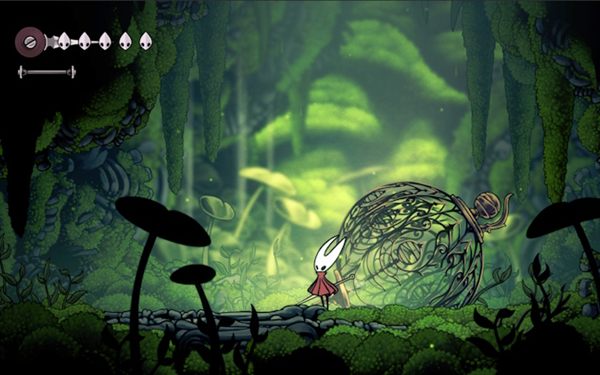
I do so love a good metroidvania. This one follows in the legacy of recent games like Hollow Knight and Ori, with many modern trimmings. For example it has an amulet system like the charms of Hollow Knight to let you customize a build of interesting upgrades, but here you can spend currency to improve each one. In each area you find a person who can sell you a map and later locations of hidden upgrades, letting you explore the unknown at first, but not waste time later in with fruitless searching. Overall it’s not as difficult as Hollow Knight (no significant currency loss on death, for example)… unless you take on the many optional platforming sequences that are brutal even to experienced hands like mine. The presentation is solid, with vibrant colors and cool cinematic moments. The combat is kinetic and deep, not letting you entirely get by mashing buttons; good use of parry and combos get you much better results. The rate of exploration is fast, letting you feel like you’re running through and racing against time… until you get the hankering to slow down and scrub for all those little secrets and power up. The Lost Crown also is the first Prince of Persia game in a long time to invoke the vibes of the excellent Sands of Time, playing with time manipulation and a storybook quality. This is a solid game that I saved for winter break so I could really dig into it.
Played on Xbox
In last year’s wrap-up I mentioned I had just started Rogue Legacy 2 while on holiday break. Well I kept with it and got significantly deeper. It’s a bit of a roguelite metroidvania, which is to say you have many runs of a randomized environment with some amount of incremental progression (roguelite) but progress to those areas is gated on traversal abilities (metroidvania). You definitely get a consistent sense of small progress here as you can spend coin on upgrading your castle for various bonuses. Each run is randomized by a choice of descendants, each with quirks that make them more powerful or less powerful (in trade for gold bonuses). And during each run there’s an interesting risk/reward tradeoffs of trading health for upgrades. I found it very enjoyable, until I hit a key milestone, ran into the next very tough boss, couldn’t decide between grinding out more bonuses or learning the boss’ patterns, set the game down and forgot to come back to it. But my time with it was good.
Played on Xbox GamePass
In this game you’ve traveled to a Bavarian-esque vacation destination that specializes in monster slaying and dungeon running (“Enjoy your slay!” say the local staff). In the evenings after your adventure you can spend time with various people in the village to build relationships (and get mechanical bonuses for doing so). It’s got a mix of 3rd person action melee and Zelda-like puzzle solving. All wrapped in pleasant cell shaded package.
Played on Xbox
And the Rest
Here are some other games that are worth a little mention.
- Cobalt Core: This game is another deckbuilding roguelite, but with you piloting a spaceship going through 1:1 ship battles. Positioning matters, where you can line up shots to specific weak points or dodge incoming missiles. You seed your deck of possible actions by choosing your crew (and unlocking alternate crew with new mechanics by succeeding in runs). It’s cute in its presentation and I’ve enjoyed the time I’ve spent with it so far, but it didn’t exactly create the crazy addictive draw of something like Balatro.
- Steamworld Dig 2: Digging through sand and earth in a video game readily evokes the likes of Dig Dug or Super Mario 2, but for some the best match for this one to me is a little indie XBLA game Miner Dig Deep. Just like that, Steamworld Dig has you increasingly delve into the earth, mining resources that let you buy upgrades to get deeper and more lucrative gains. Except this one looks a lot better. And tries to squeeze in a plot, but I was much more satisfied by the simple digging loop. Which is limited by how much lantern light you have… until you buy an upgrade that removes that mechanic and with it all of the tension. You do get a sweet grappling hook for navigation at some point though which is really great. I wandered off from this game at some point when it strayed too far from the simple digging roots, but it was fun until then.
16 Aug 2024
My friend Cody has been pitching a replacement for the granular 10 point BGG rating scale:
1 - bad won’t ever play again
2 - didn’t care for it, won’t actively try and play it again
3 - liked it, would definitely play again, maybe even buy it
4 - actively want to play again and would like to buy so I can play as much as often as possible
To avoid confusion with BGG number ratings, I’m going to use ⭐️ for the Cody scale. Sorry, didn’t pitch it as a star system, but it’s hard to compare without some different indicator.
My suggested rough mapping:
- BGG 8-10 maps to 4 (⭐️⭐️⭐️⭐️)
- BGG 6-7 maps to 3 (⭐️⭐️⭐️)
- BGG 4-5 maps to 2 (⭐️⭐️)
- BGG 1-3 maps to 1 (⭐️)
⭐️⭐️⭐️⭐️
Anything BGG 8 and up is something that as a board game person (someone with a collection) I want to own. These are all great. So… smoosh them all together into a single ⭐️⭐️⭐️⭐️ rating, sure. I’d lose a bit of definition in what are my greatest of all time, but that’s fine. I’m still heartily recommending any here.
⭐️⭐️⭐️
To me the BGG 6s and 7s map to “would play again and maybe own”. I own plenty of 7s. I also own 6s, but something at a 6 is asking to be phased out of my collection. Famously, the BGG 7 rating is the most crowded, with 7.0 being borderline okay and 7.9 being amazing. So having all these (plus the decidedly situational 6s) as ⭐️⭐️⭐️ is similarly covering a lot of ground and I’d guess this is the most dominant rating and lacking in clearer signal.
⭐️⭐️
The summary of ⭐️⭐️ is “yeah, if someone else is pushing to play it I will, but I’m not going to be the one asking for it.” Which is not something I want in my collection (otherwise people will see it on the shelf, ask “can we play that?” And I’ll go “uh… sure?”). That maps to the BGG 4s and 5s, the mediocre to reluctant.
⭐️
Anything BGG 3 and under is different flavors of garbage. I have no love lost lumping that into ⭐️. It’s not like I’m going to walk someone through the nuance of why one is slightly less terrible than another. They’re all bad, run away.
Thoughts
Overall, what the Cody scale asks is “what extra are you communicating by letting people rate on a 10 point scale? I do think it’s overkill for most people, and that the extremes aren’t providing critical information. However with this system I do think you’re going to have a crowded set of ⭐️⭐️⭐️ just like you had crowded 7s. And I do think people want to know if a title is more trending towards ⭐️⭐️ or ⭐️⭐️⭐️. The question is whether individual raters communicate that or whether that’s the job of review aggregation to add in the decimal point.
Would it get more casual folks to rate things and overcome the BGG hardcore’s oversized influence of the top games? Maybe a little. But honestly, who other than the hardcore rates anything? Am I in any way contributing to the ratings on Amazon items, or what gets rolled up into MetaCritic for video games or Rotten Tomatoes for movies? Nope. I give zero input to those systems. Most of the ratings systems I’m coerced to interacting with are of the variety of “give 5 stars or you are sabotaging someone’s livelihood,” which is its own problem and leads us down the path of that Black Mirror episode with Bryce Dallas Howard. Yikes.
Thankfully that’s not the vibe here. A 4 point scale seems fine. If you can make it happen, go for it Cody. In the meantime I’m going to stick to the BGG scale because that’s the only place I know people actually look at ratings.
08 Aug 2024
After I created my first pedalboard, I learned so much, and assembled a second board. Let me go over the contents of my second board, in signal chain order.
When I started playing guitar I would tune myself to match songs off the radio (don’t recommend) until I learned how to use a pitch pipe (better, still not good). In more recent times I would use a phone to tune, but I hated it. Interacting with my phone while I want to be in a guitar playing headspace is the anti-vibe. Just this last year I got my first headstock clip-on tuner, and it’s a revelation. With that I didn’t have as strong of a need for an on-board pedal tuner, but I’m glad I got one.
The Polytune is one of the most popular tuning pedals available. It’s main differentiator is that it can tell you the tuning accuracy of all your strings at once with an open strum. In theory this lets you quickly identify which string is out of tune, which is neat, but not something I turn to often. What I find more useful is the live readout of whatever pitch I’m playing. That can reinforce knowing the note names of what you’re actually playing, or help you figure out unfamiliar instruments by piping a microphone into your board.
At first I had the tuner set up to go out of a forked output from my Ernie Ball VP JR volume pedal. This meant that when I quieted via the volume pedal the tuner would still function for silent tuning (without needing to engage its foot switch). I’m currently not opting for this configuration because it just means one extra cable to disconnect and connect when I pack the pedal board.
This demo sold me on the Attack Decay. But I hedged by getting the smaller “pico” version of the pedal, worrying that it was a nuanced effect not worth of board space. That was a mistake. One of the highlights is sending the threshold triggered signal through another set of effects in a separate send/receive loop, with is only present on the larger version of the pedal. Additionally the larger pedal has a fuzz effect built into it. As it’s an EHX pedal, as far as I can tell that a Big Muff style fuzz. So the pedal doesn’t need to a quirky toy, it can be a fuzz pedal that also does fun quirky stuff. Once I realize that, I got the larger version of the pedal and bumped the Big Muff off my board.
The bigger pedal also has 3 programmable favorites. Currently, mine are:
- Basic fuzz
- A trigger for a low growl of fuzz on stronger notes, which is very satisfying when playing a lead line
- A bow-like effect with late attack and quick decay
I have the send/receive going through a Behringer Graphic EQ, set to create a kind of AM radio vibe that makes the fuzz feel more distant from the dry signal. I’ve also tried putting in a Flamma FC05 Mod so I can experiment with ways to make the effect signal unique. But as far as board space goes, I don’t want to dedicate a whole second stream of petals just for this occasional effect.
I got the Q-Tron because it’s on John Mayer‘s board and appears prominently in a couple of his songs. It’s an envelope filter, effectively an auto wah. It creates truly funky tones that have a quacking vowel sound to them. It’s very sensitive to signal levels, thus why it’s so early in the signal chain. It’s one of my least used pedals, but when the song is right for that vibe this is a super fun sound.
The Pitch Fork is one of my most used petals, primarily because it’s quicker to downshift my guitar one octave with this pedal then to swap in a proper bass guitar. When I’m laying down a loop, I’m gonna need a bass line, and this gets me there fast. Mind you, the pedal does a ton more than that. It can thicken your sound by adding octaves above and/or below, with or without your the dry signal. Or you can do the same thing with fifths (power chords all day), fourths, thirds, or even a warbly detune. I haven’t yet become a regular expression pedal user, but this is one of the few pedals where I’ve played around with attaching a pedal.
When I went down this pedal rabbit hole, I looked at a lot of people’s boards on Reddit. And you see the Morning Glory on a ton of them, often described as an “always on” pedal. I don’t leave mine on all the time, but it is definitely a common add of special sauce that makes everything sound nicer. It’s some subtle boost and crunch that’s easy to switch on without losing anything, or to stack grit into my drive effects which come afterwards.
I got the Triumph as a flexible EQ overdrive pedal. As with many pedals, I was directed to it by The JHS Show where it was described as a better Bad Monkey. It saves me space over something I had done before which is putting an EQ pedal directly after a drive pedal to shape it. This lets me do that in one pedal. But then I went and stacked a total of four drive pedals on my board and that leaves me less interested in fine adjustments to the sound of each of them. Instead I leave this one dialed in somewhere that sounds different from the other three drive pedals and call it good.
I was charmed into the PG 14 pedal by the infectious energy of Paul Gilbert‘s multiple videos done in partnership with JHS to promote the pedal. I had never heard Paul Gilbert play before, which makes it weird that I have his signature pedal (named for his shoe size) on my board. But this thing sounds freaking awesome. It gets to this crunchy almost glitchy space that sounds so raw and cool. So that’s the configuration where I leave it by default, but I also know from prior experimentation that I can turn it into a number of different sounds if I need to.
I regretted not buying a DS1 in the 90s when I should have. I probably would’ve played my electric guitar a whole lot more. This pedal sold 1.5 million units for a reason. It sounds great. Bright and crunchy, good for lead lines or for rhythm. I squeezed this off my board for a bit because I had fancy new pedals… but when I tried hooking it up again I realized it really did earn its slot. It’s a classic.
I’ve never been ecstatic about my EHX Small Stone, as I could never get its phaser effect to be subtle enough for more frequent use. The Lillian fixes that handily by having a mix knob, but also so many other knobs that let me dial in a variety of gentle (or not gentle) phasing. That makes me a lot more likely to stomp this switch. Additionally, as one of my later acquired pedals I felt like I could choose one that I vibed with aesthetically, and the art on this pedal is great.
When I saw the amazing art on the Julianna, I stopped in my tracks. But chorus hasn’t been an effect that I got on with well enough to warrant a board slot. So why not a chorus pedal that’s for people that aren’t so into chorus? The Julianna demo video from Walrus Audio sold me on this being a tone I was interested in… but the Julianna is the more advanced stereo version of the Julia, with a higher price to boot. So I opted for the Julia instead. And my instincts proved correct; I’m far more likely to use a mild chorus.
I love the sound of tremolo. Technically my amp has tremolo built in. But it lacks additional controls, and using the amp’s tremolo has the drawback that I might want different levels of tremolo on different overdubs within my loops. So I got a tiny standalone tremolo pedal. The Tidewater meets that needs tidily. I can control the rate and it has an indicator light to help dial that in. Plus I can adjust the mix to give a more subtle volume modulation.
As mentioned in my lessons learned, I was interested in a combo reverb/delay to cut down on wiring complexity. An often recommended option for that is the Keeley Caverns. In researching that I found the Parallax as a similar pedal with different options on the reverb side. It has a “shimmer” hall option, reverse reverb, and a “soft focus”, all of which give me something my previous reverb (EHX Holy Grail didn’t have. There are an intimidating number of knobs on the Parallax. Or at least that’s how it felt at first. This is one pedal where I’ve most engaged with its various settings. I can dial it in for a more standard reverb and a short “slap back” delay, or I can crank everything up and take it into orbit.
My experience with looping warrants its own post. But I’ll summarize by saying that upgrading my loop pedal was one of my most researched and most impactful decisions. Specifically I opted to trade up for something that had rhythm and had 2 loops so I could do verse/chorus alternating improvisation. I use this constantly and I absolutely love it. The only thing lacking is that I want to get an external foot switch to add tap tempo.