06 Aug 2008
Played on Xbox360
Given the reviews I knew that Stranglehold (sorry, “John Woo Presents Stranglehold”) probably wouldn’t rock my world, so I guess I wasn’t too disappointed when it didn’t. It’s not bad, but I certainly wouldn’t recommend it over all the other games out there. The premise is solid: a shooter with crazy destructible environments and a combo system that awards you for taking dudes out with style. But the execution of that premise left something to be desired.
The first style system I remember was from Project Gotham Racing. It had these challenge modes where the goal was to string together longs stretches of flashy moves while keeping up a fast pace and not bumping into anything. If you were really good you could keep one combo going for the entire circuit and get a crapload of points. Stranglehold tries to integrate a similar thing into its shooter mechanics, with you being rewarded for stuff like making a headshot while leaping through the air dramatically. Instead of getting points you fill up a meter that lets you heal yourself or unleash devastating barrages. Unfortunately the game has overly simple rules for detecting how suave you are, resulting in your best performances going by unnoticed while some sloppy mishap gets you tons of points. The adrenaline is there keeping you gunning for a longer streak, but the inability of the system to correctly gauge flair makes the whole experience feel slightly disconnected. It becomes clear pretty early on that the best way to get style points is to game the system, not to actually have any style.
It doesn’t help that the weapons are uninspired. There’s a long stream of guns that mostly feel identical. I know I’m spoiled by games that have the luxury of inventing death rays and plasma rifles, but realistic weaponry doesn’t have to be so spectacularly generic. My advice: concentrate on fewer weapons but make them feel like they pack a punch. Anyway, from a game about gunplay I expect more.
The plot of the game is generic action movie fluff. You’re a cop who doesn’t exactly play by the book, and at some point I think the chief asks you to turn in your badge, although I could be confusing it with a dozen other action cop flicks. For a video game a generic plot is the norm, so he plot is perfectly satisfactory. The audio leveling, however, is not. This isn’t the first time I’ve complained about being unable to hear story sequences in a game. It felt like I was watching FOX, where the commercials are many levels louder than the program you care about. Each time a story sequence came up I had to crank the volume, and then I had to remember to turn it down again as soon as the action started again. If they were looking for an efficient way to break my immersion, then mission accomplished.
Thankfully the destructible environments mostly distracted me from the lackluster gunplay and varying sound quality. While the bullets are whizzing by whatever area you’re in gets torn to shreds. At the end of large fights I often
04 Aug 2008
Played on Xbox360
I’ve been doing the GameFly thing for quite some time now, and I’ve noticed that my play style has changed somewhat. Gone are the days of playing only a handful of games, but playing them so deeply that I know every last inch. I don’t think it’s correct to say my taste has changed, but I do think it has expanded. I now seek out games where the reviews criticize it for being “too short.” I often would rather have short but memorable experiences with multiple games than a long deep relationship with one epic game. I’ve shifted to be a gaming polygamist. That’s not to say that I don’t enjoy deep, long-term gameplay (just look at how much MMO blogging I do), but I’ve now got a soft spot for the short but sweet weekend rental.
Conan is just that sort of game. Not to be confused with Age of Conan, the MMO, the Conan for the Xbox 360 is a simple third-person action slash-fest. You are Conan, and you kill stuff. And being the barbarian badass that you are, you vanquish your foes with gratuitous force. It’s quite satisfying.
There’s nothing terribly complicated about the core gameplay. There are three primary attack buttons and different combos for various sequences of these attacks. For the most part you can mash buttons and watch the carnage unfold. Later in the game you’ll encounter foes that require you pull off specific combos to get passed their defenses, but it never gets too intricate. All told the combat feels pretty solid.
The boss battles in Conan are appropriately grand. You fight everything from a sand dragon to a kraken to an undead elephant. Seriously, the game gets major points for memorable boss creatures. Defeating the bosses involves a mix of standard combat and Quick Time Events. Thankfully the QTEs are lenient and never immediately fatal, so defeating a boss is never a matter of repetition until you achieve perfection.
You may be reading all of this and thing to yourself, “But I’ve played this game before.” Yes, Conan is the posterchild for derivative game design. There is absolutely nothing here that hasn’t already been done in dozens of other action games. But it’s done well. Combat feels good, the animation is great, the bosses are memorable, and the whole experience only takes up about five hours of your time. This is the video game equivalent of the popcorn action flick. It won’t give you any deep and meaningful revelations, but it sure is fun.
That’s not to say that the game is lacking character. Conan may be a man of few words, but those few words are delivered well and are absolutely hilarious. The game has a charm to it. It’s a chauvinistic and violent charm, but for some reason in the world of Conan the Barbarian that’s totally endearing. For example, instead of collecting hidden packages, flags, or agility orbs, Conan seeks out topless women chained to poles. They strip off their shackles and thank Conan suggestively… achievement unlocked. It all sounds really offensive, but it fits thematically, and for some reason that makes it okay. Don’t get me wrong, this game is not for the feint of heart. But for a five hour romp of decapitations and one liners, it’s excellent.
29 Jul 2008
I’ve been having a good time with Last Night on Earth, but poking around on BoardGameGeek I’ve always been a little jealous of those swank miniatures that some people have painted. I’ve also noticed that it’s very possible to confuse the heroes while playing, so the painted figured do serve some functional value. So I decided to take up an arts and crafts project to paint the pieces from my game.

I’ve never painted anything like these soft plastic miniatures before, so I posted a query to the BGG crowd for tips. And I’m so glad I did, because those people were ridiculously helpful. Armed with pages of discussion on optimal painting techniques I headed to Michael’s to get my materials.

Supply list:
- Apple Barrel 24 color acrylic paint set - $4.99
- Apple Barrel white, 2oz - $0.79
- Apple Barrel black, 20z - $0.79
- Delta Ceramcoat matte interior varnish - $2.29
- Loew-Cornell set of four sable brushes - $6.99
- Elmer’s adhesive putty - $1.99
- Solo bathroom cups (package of 80) - $2.39
Total: $21.88 (including tax)
The first step was to wash the minis. Apparently they have some residual stuff on them from the mold, and if you don’t wash them the paint will have problems sticking. So I washed all the minis and left them to dry for a couple hours.

The next step was to prime them. I started with the zombies, because you’ve gotta screw up pretty fierce to make zombies look bad. Two coats of black paint later, my zombies were looking like freaky little tar monsters.

Someone from the boards had the excellent suggestion of using sticky tack to affix the figures to something so I didn’t have to actually touch the figure while painting. Thus the plastic cups. There are two colors of zombies, green and brown, and since I needed to preserve that in my final output I marked the cups with either a “G” or “B”.

With all the prep complete it was time to break out the color. I wanted to preserve the original skin tone difference between the two sets of zombies, so I mixed two not-quite-human skin colors. After the skin was painted on zombies I was able to go nuts applying various clothing colors to them, making full use of the 24 colors in my palette. Lastly I finished off the bases, starting with a dark-green base (to match the game board) and then accenting them with either a light green or brown to bring back the two zombie team colors.

The final step was to apply a coat of matte varnish to make sure that the paint won’t wear down as the figures get handled during gameplay.
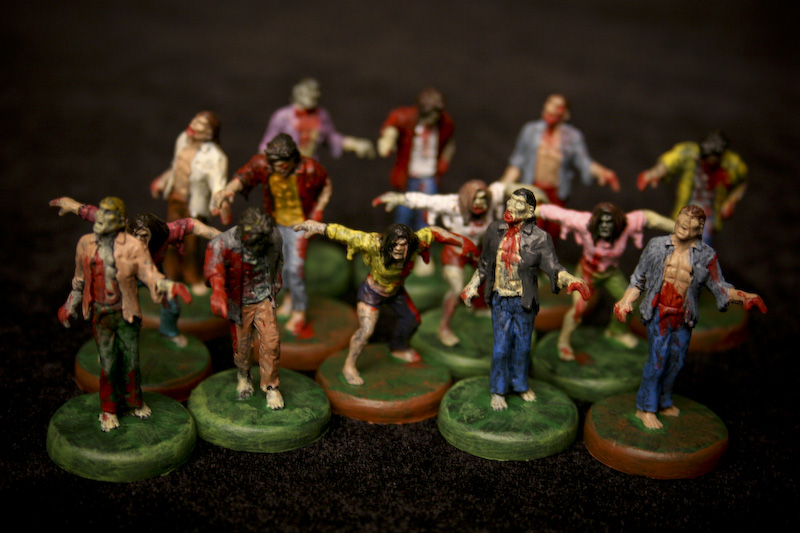
You can see more photos of the final result here. Personally, I’m extremely happy with how they turned out. Now that I’ve cut my teeth on the zombies, the next step is to tackle the heroes. There’s more detail to worry about with the heroes, but the core steps should be the same. I’ll post photos when I’m done.