16 Sep 2010
It’s common to have a video game release alongside a film release as some sort of companion marketing synergy something-something. It’s rare that I actually experience those products in tandem as intended. But that has been the case with Scott Pilgrim vs. the World. So I have two pieces of media to process here, both of which have increased my curiosity about the original source material.
I actually technically started with the game, but I’ll begin with the movie. If you are not in an extremely specific demographic, then this movie isn’t for you. If you’re old enough to have predated the video game generation, then the whole thing is going to feel like a whirlwind of predictable, repetitive, superficial bubblegum. If instead you’re too young and had your video game cherry popped by Halo or Grand Theft Auto, then you won’t connect with the references or the 8-bit stylings. In short, your ability to enjoy this movie may be limited by whether you know what a bob-omb is.
I guess I should have known I would have liked the film, as that the director’s filmography includes Hot Fuzz and Shaun of the Dead. Both of those movies understood their genre well, and Scott Pilgrim is no different here. The film feels like some delicious blend of video game and comic book. That’s either going to come off as cheesy or awesome, depending on your perspective. I did hear a groan from the audience when the movie took a left turn about twenty minutes in with its first boss battle. It reminded me of the time I saw Crouching Tiger in the theater and there was a similar confused “what?” that came from the crowd when a character in the film started to fly. Please, get over yourself, suspend your disbelief, and enjoy this alternate slice of reality. Physics be damned.
In short the plot is that Scott Pilgrim falls in love with Ramona Flowers (and with her vibrant hair, goggles, mystery, and deep brown eyes who can blame him?), and must progress through a series of seven boss battles to win her. The progression of the film is entirely predictable. You will know after a scene without looking at your watch about how much movie is left. But it’s really no different than knowing that the solution that House comes up with 20 minutes in is wrong and the one he comes up with 5 minutes from the end is right. It’s just narrative structure. But, you know, with boss battles.
The movie was paired with a coordinating game release for XBLA and PSN. The game is a classic beat-em-up, in the style of River City Ransom or Double Dragon. Unlike Castle Crashers, this modern beat-em-up makes no effort to modernize the visual style. The Scott Pilgrim game is blissfully low tech, with pixelated sprites and chiptune music. Oh my god, the music. So catchy, so good. Or at least it is to my nostalgic ear. There was one tune that started to grate on me, but that’s because the loop was too short and the level was too hard. But overall the audio experience is delightfully old school.
Generally the point of tying two media releases is to motivate you to get into one if you’re initially only into the other. The expectation I’m guessing is that if you’re excited about the movie you’ll get the game, not as much the other way around given that movie license games are usually terrible. In this case I guess I did it backwards - as that I picked up the game because I heard it was good. I didn’t form plans to see the movie until I heard that it was also good, although I guess the game did get me a bit more excited for it. Not that I helped - the movie had already been declared a box office failure in the short weeks before I got out to see it. It’s sad how immediately things are judged. It’s the same logic that gets an amazing show like Firefly canceled. Oh well, I still heartily recommend both Scott Pilgrim the game and Scott Pilgrim the movie to anyone who fits in that demographic (and if you’re in it, you probably already know).
11 Aug 2010
Played on Xbox360
Before playing Darksiders, I had already heard a lot of press about how the game is just one big Zelda rip off. It is accused of unabashedly stealing mechanics from that franchise and others. And you know what, that’s no lie. But I fail to see how it’s a problem. The Zelda games are almost uniformly excellent. And there really aren’t many other games that attempt that gameplay style. So really, there’s low supply and high demand for Zelda-style games, and something like Darksiders should be perfectly welcome. I mean, were people really upset when Shadow Complex blatantly cribbed from Metroid? I’m glad the gaming industry isn’t as crazy about patents as the rest of the software world - it prevents the culture from stagnating.
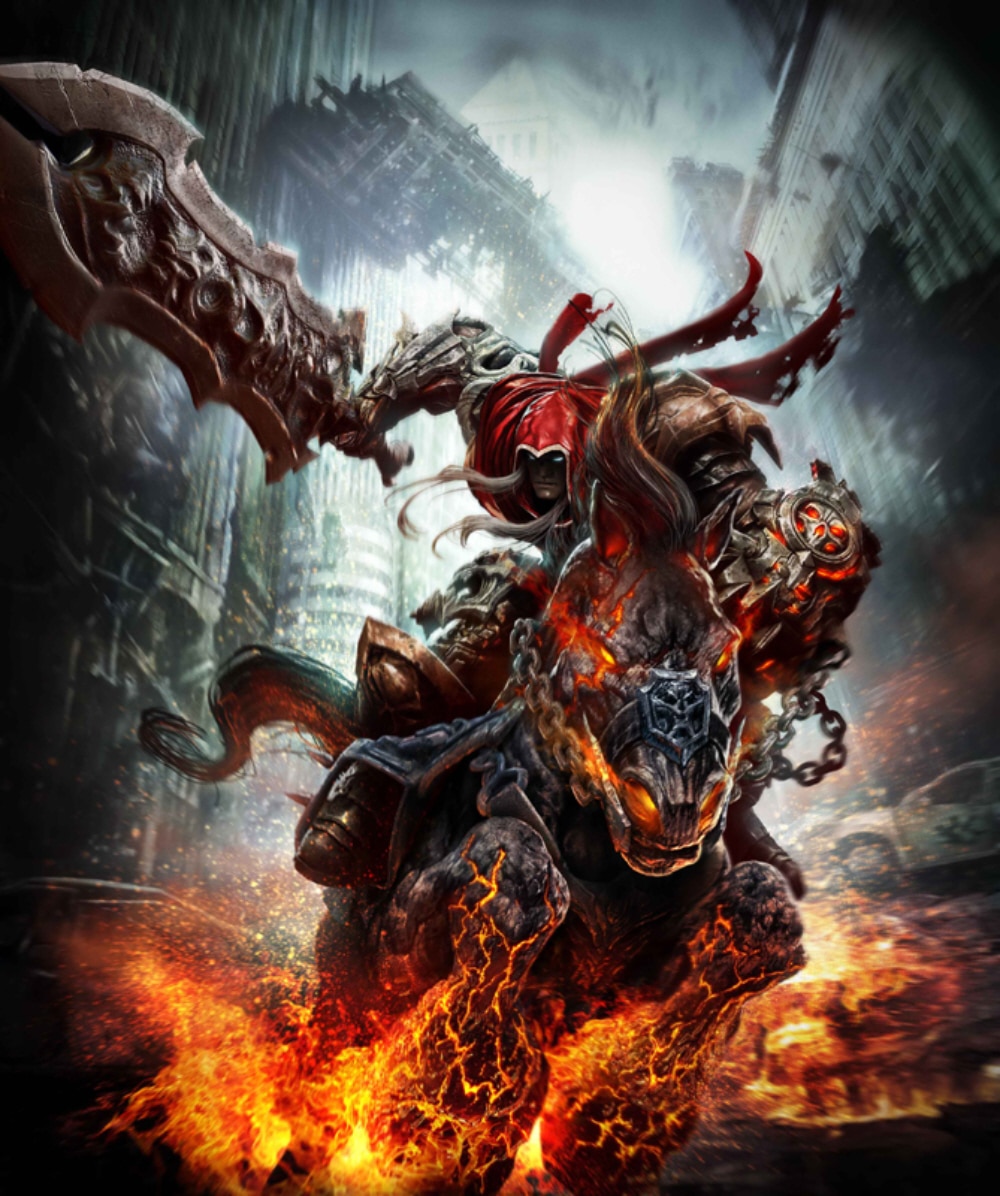
When the cell shaded art style for Wind Waker got unveiled apparently a ton of fans were mortified. They wanted some more realistically rendered adult Link. Personally I loved the light hearted cartoon style of Wind Waker. But if some people were still holding out for a grittier, more “adult” Link, then they have it in Darksiders… and then some. Darksiders takes place in a world where angels and demons are battling it out over a post-apocalyptic Earth. You play as War, one of the four horsemen, standing in the middle trying to keep both sides in line through extreme violence. It’s like if Link started rampaging around making demonic pacts and cutting people’s head’s off. Instead of, you know, occasionally harassing chickens.
That theme may not align to your typical Zelda game, but the mechanics are all familiar. You get a boomerang and a hookshot; you’ll romp through dungeons with chests, puzzles, and keys; and at the end there will be an epic boss battle with some pattern you need to learn that involves the fancy tool you just found. It’s undeniably the same design. But it’s all executed very well.
Truth be told, I think I preferred it to Twilight Princess. The visuals are obviously of a higher fidelity, but there are also a lot of surprisingly inspired environments. The controls are tight and responsive (at least compared to my regrettable experience of playing Twilight Princess on the Wii instead of the Gamecube). And overall the game is just that much more streamlined, with a manageable length (which for me is a positive characteristic these days). Overall Darksiders was a nice little game that took a beloved pattern and repeated it. It totally scratched the right itch, so if you’ve been feeling the need for a classic Zelda romp, then give Darksiders a spin.
04 Feb 2010
It amazes me how much we communicate to each other with just our faces. With all the fine muscles behind them faces can be extremely expressive, so it’s not the capability that amazes me. It’s the accuracy with which its interpreted. Fundamentally, we rarely see our own faces. We even more rarely see them while they’re delivering all these subtle emotional cues. It blows my mind that we operate at this level where I can nonverbally make some facial contortion to represent a rather nuanced emotion and that someone else can understand that.
We never took facial communication classes where we all sat in front of mirrors practicing our vocabulary. No, we learned this all in the wild. And we started pretty young. It’s never been intuitive to me that babies learn the complexities of speech long before they learn to not poo themselves. But they’re picking up and delivering facial cues well before they start babbling. So really the language of the face is the first mode of communication we learn. This stuff is deeply ingrained in us.
Since we can’t see ourselves, all of this has to be learned by making a face and judging reactions. Maybe we will just invent some combination of muscle contractions that seem to represent our inner state, but it’s more likely that we’re copying a face that we’ve someone else make. Which, since we can’t see ourselves and judge the success rate, could have hilariously bad execution.
There are some smiles that are cold, forced, and unbelievable; there are others that are delightfully contagious. Some of this may have to with aptitude, but a lot of it has to do with the honesty of the emotions behind what’s being presented. I’m sure that the good actors spend an absurd amount of time in front of a mirror learning how to lie with their face (so either they had raw talent, or they’re just narcissistic?).
I wonder sometimes how well I filter what I’m feeling inside to what my face is projecting outside. I don’t know of course because you can see it and I can’t. If I’m feeling something powerful, can I repress it? If there’s something I dislike, my instincts tell me to make a foul face. If it’s something small, my cultural filters kick in and I can prevent the emotion from making it my face and being inappropriate. But if the emotion is stronger it becomes more and more difficult to not wear that on my face. And if it’s strong enough, there’s no stopping it. If I feel love, how can that not be read in the details big and small written all over my face? Even my eyes alone are going to carry a message that clear. But with the whole face in concert? For something that big you’re going to get communication on all open channels.
Love is obviously an emotion that we rarely have a reason to repress, but there are plenty of things that we do need to keep from making it to the surface. There are all sorts of things flying through our heads, and every one of them shouldn’t vent out through the face. Well, unless you want to look like the crazy person that you are on the inside. So it is that we’ve all developed a controlled path from emotion to facial communication; we all have filters, conscious or unconscious. We have some knowledge of our facial vocabulary and are making decisions about which faces to put forth based on proven effectiveness and relevance to the situation.
Although our potential vocabulary is large, it’s always being refined by the reaction we see in other people. When we make a face, we’re looking for the reaction face in other people. If we perceive that reaction to be positive, we’re more likely to use that face in the future. Or maybe their positive reaction causes us to return a positive reaction, and it all cycles until we’re just standing their grinning like idiots.
I don’t know where I’m going with this. The topic just completely fascinates me. How much of myself is projected with completely subconscious imprecise facial communication? How accurate is what I put out there? Can everything I’m thinking be plainly read on my face? I really have no clue how well I communicate what I’m feeling, or how well I conceal the thoughts and emotions I don’t want other people to see. I can know what I’m saying, because I also have ears. But I have no idea what my face is telling you.
:/